The Discovery and Excavation of the Mary Rose - page 1 of 4

Alexander McKeeThe search for and discovery of
the Mary Rose was a result of the dedication of one man, the late Alexander McKee.
In 1965, in conjunction with the Southsea branch of the British Sub- Aqua Club, he initiated project 'Solent Ships'. While on paper a plan to examine a number of known wrecks in the Solent, Alex McKee really hoped to find the Mary Rose.
Ordinary search techniques proved unsatisfactory so something different was needed. The answer was side-scan sonar. The collaboration of Professor Harold E. Edgerton (MIT) and John Mills, the British representative of his firm EG & G, led to the discovery of the wreck site. They provided the sonar systems and operated them, and in 1967 discovered a strange sub-seabed anomaly. This was confirmed by a further sonar survey in 1968. Alex McKee believed the Mary Rose had been rediscovered. In his fascinating book, "How we found the Mary Rose," he summarised the sonar data in a letter to Professor Edgerton as follows.
"(a) an oval shaped feature about 200 feet long headed towards No Mans Land Area.
(b) the interfaces give the impression of a flattened letter 'W'. i.e., they are exceedingly angular and nothing like the rounded shapes of the clay interfaces. They are smaller at the ends than in the middle. Oh, ho!
(c) the feature appears to form some sort of discontinuity or 'break' in the geological strata, and as this cannot be the results of an earthquake the hypothesis that it results from the insertion into the seabed of 700 tons of battleship seems likely, particularly when we consider that the findings at (a) are consistent entirely with the wreck of the Mary Rose.If the suspect feature proves to be the Mary Rose, then I expect we shall be able to claim the carrying out of the first electronic trenching survey of a sub-mud historic wreck."
In November 1967 the Mary Rose (1967) Committee was formed. This consisted of Alexander McKee, Margaret Rule, (who had been providing archaeological advice almost from the start), W.O.B. Majer and Lt-Cdr Alan Bax. This organisation then leased the area of the seabed around the site for the grand sum of one pound per annum.

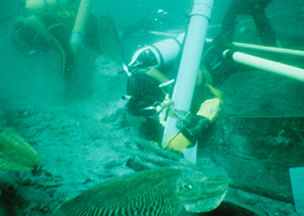
Diver using an airliftWhat was needed now was proof that the anomaly
was indeed the Mary Rose. Between 1968 and 1971, diving on the site
was carried out by a team of volunteers who called themselves Mad
Mac's Marauders. This was accomplished from very small boats and
on a vanishingly small budget. Indeed, the funds to support the
project were often provided by the team themselves, there was
no sudden influx of capital. In the winter of 1968, they confirmed
the existance of something solid under the silt using probes.
The excavation continued, using waterjets. a dredger to help remove
the overburden, and airlifts.
They were encouraged when stray pieces of timber started showing up, and then the dredger brought up an iron gun. Because the gun started deteriorating as soon as it was exposed to air, it had to be sent for conservation as quickly as possible. Alex McKee radioed Portsmouth City Museum to tell them when the gun would be sent ashore, and in his own words states.
"After so many years of deing denigrated behind my back as a mad chaser after wild geese, it was with great satisfaction that I saw the message go off."
The climax to this operation came when, on the 5th of May 1971, Percy Ackland discovered three of the port frames of the Mary Rose. In Alex's book he quotes Percy as saying.
I looked ahead and saw an indistinct dark object. I moved towards it. It looked like a frame. IT WAS A FRAME! Eroded at the top like a pyramid about two inches by ten inches.
Six inches away was another one, and beyond that another.I moved along, noticing they ran north to south; I found more frames - only this time with some planking attached. I touched it, half to reassure myself it was real and half to check the width of the planking which was about four inches. I swam along all the frames visible above the seabed. This must be the Mary Rose.
Alex McKee and his team had seen their years of searching pay off in the biggest possible way, they didn't know it yet, but they had not only found the wreck, but also a treasure trove of beautifully preserved Tudor artefacts. If you are wondering why I haven't told more of the story of the discovery of the Mary Rose, it is because Alexander McKee does it far better than I can in his book!
Commemorative Dive
On 14th May 1966, the first modern dive was made on the wreck site of the Mary Rose. That dive, in conditions of almost zero visibility, was the first of many thousands looking for evidence of the wreck, and led ultimately to the ship being raised in 1982. In 2005 John Towse and other members of the original dive team presented the Mary Rose Museum with the original search chart.
Alexander McKee and John Towse made that first dive. Mr. Towse made the pilgrimage to the spot 40ft below the Solent 30 years on with some of the original divers, including Alex McKee's widow, Ilsa. They even used the same dive boat used in 1966: Gina Anne, now renamed Harmony.
Alexander McKee died in 1992, aged 74, 10 years after the wreck was raised. Those taking part in the commemorative dive remembered Alexander McKee's boundless and infectious enthusiasm.
Back to top