bronze gun in the Mary Rose Museum

Armament - Page 9 of 9 - Handweapons

The Mary Rose Sword - Alexandra Hildred

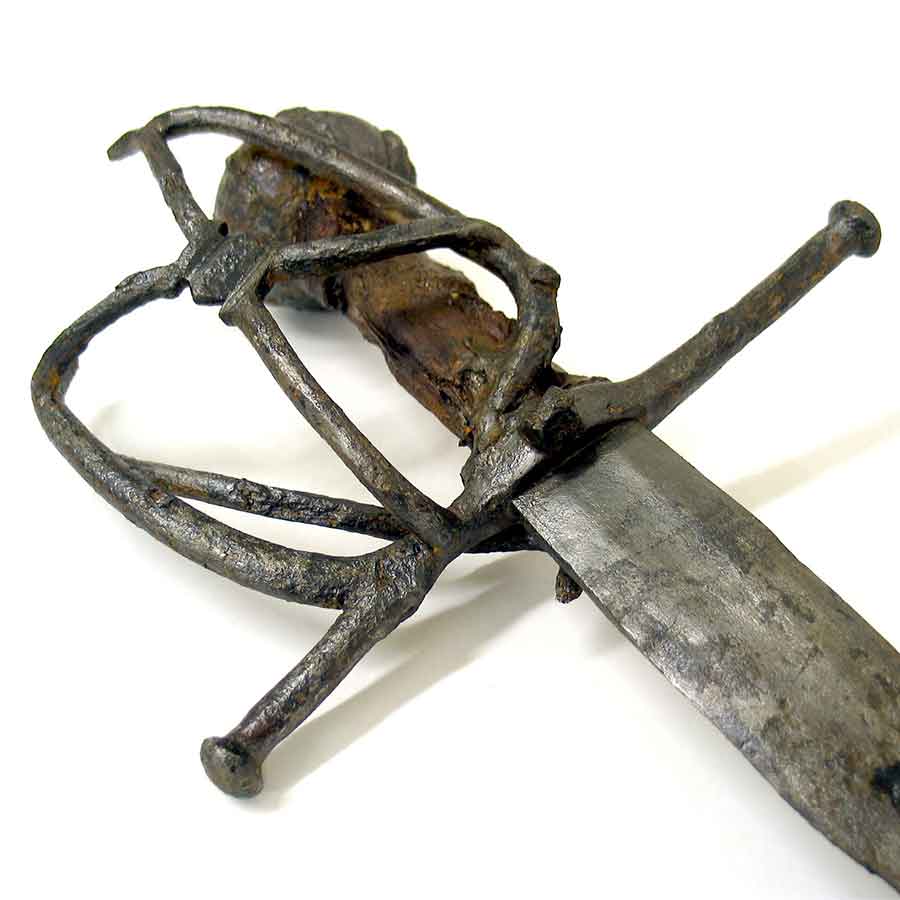
Mary Rose swordThe officers on the Mary Rose would have carried swords and in 1982 a nearly complete iron sword was excavated from beneath the sterncastle of the Mary Rose. It had fallen through one of the gun-ports on the main deck and was preserved beneath the ship. The sword was excavated during the phase in the recovery when tunnels were being dug under the ship to allow the divers to secure the ends of the lifting wires. The sword is 105cm long and is nearly complete. It is a basket-hilt sword, so called because of the shape of the hilt, formed of a network of iron bars.

Although a number of both English and Scottish basket-hilted swords survive, none of these are as precisely dated as the Mary Rose sword. The sword was incontrovertibly on board the ship when she sank on July 19th 1545. The only two other English basket- hilted swords with any form of contextual dating are both from sites of towns or castles which were destroyed during the English Civil War and have been dated 1645 (Basing House) and 1646 (Sandal Castle) respectively. The Mary Rose sword is therefore the earliest precisely dated basket-hilted sword in England and is of paramount importance within the context of the evolution of this controversial type of sword.

The origins of the basket-hilted sword have been disputed by a number of scholars over the years, but recent work points to the origins of the domestic form of basket-hilt as being British; either Scottish or English. The similarity of the form to the more elaborate Scottish Claymore, sometimes merely described as the "Scottish Hilt", has led scholars to assume that the simpler forms of basket-hilt were predecessors to the true Claymore of the late seventeenth century. No precisely dated example exists in Scotland during the sixteenth century, with only vague literary and manuscript references to the 'basket-hilt'. It is therefore arguable that the Mary Rose sword could be regarded as being a predecessor of the Claymore, giving an English origin to the basket-hilt. The Mary Rose sword can therefore be used as the lynch-pin upon which all the other dating by complexity in form (later than 1545) and simplicity in form (earlier than 1545) is based around when considering the development in sword hilts.

Relatively few examples exist either as extant swords or in manuscripts and paintings. It has been suggested that this is due to the fact that the basket-hilt was almost exclusively a "utilitarian and military" weapon (Blair 1981). Many swords are therefore plain and lack decorative features which may help with the dating, and many were probably not kept due to their mundane nature.

The Mary Rose sword has never been on display before, and is still undergoing conservation treatment. It has a blade of 88.5 cm formed by the forge welding of a piece of iron and a smaller piece of medium carbon steel. The composite bar was then forged into the shape of a blade with the thinned steel portion forming a surface layer around the edge.

The double edged blade was hardened by quenching and then tempered. This resulted in a hard cutting edge and a softer, less brittle body. The tang of the blade passes through a wooden grip (either beech or alder) and the hollow spherical pommel made of a quaternary alloy composed of copper, zinc, tin and lead. The pommel is made in two hemispheres, joined horizontally. It is decorated with simple strips of iron radiating from the pommel button, visually dividing the pommel into eight sections. Although no vestige of silver or iron wire can be seen, 18 of the 25 sword grips recovered from the Mary Rose exhibit vestigial remains of either iron or silver and 14 clearly show imprints in the form of a wire covering. Although some of this is restricted to the top or bottom of the grip this may be due to initial corrosion and/or post-excavation treatments.

Remains of textile at the top and base of the grip suggest textile decoration or covering. The basket hilt is in the form of a saltire with central rectangle which is carved to resemble a simple baluster moulding. The hilt is crushed and the end of one of the bars forming the saltire is broken at it's lower end. All the bars are of rounded form and the quillions are straight with simple finials. There is no defined knuckle guard, although there is a possibility that some form of guard was present. The hilt has lost one of the inner arms. There is no evidence, either vestigial or from a study of the radiographs, to suggest that any of the bars ever entered the pommel.

References:
Blair, C. 1981, The Early Basket-Hilt in Britain. In Caldwell (Editor), Scottish Weapons and Fortifications, Edinburgh, 1981
Wilson, G. 1984, Notes on some early Basket-Hilted swords.

Back to top